Everyone's Adding AI Agents. Is Yours Actually Working?
Adoption is way ahead of proof. Here's a simple way to tell if your AI agents are actually working, plus a chance to get one built for your org, on us.
AI agents are showing up in Salesforce orgs faster than anyone is checking whether they're actually helping. Most teams track activity, like how many tasks an agent touched, instead of outcomes, like whether anything got faster, cheaper, or more accurate. This post walks through why that gap exists, three simple questions that tell you if an agent is really working, and how nCoder.ai helps you build and measure AI that's actually tuned to your org, not just switched on and hoped for. Stick around, we're also giving away 20 free custom AI instances this month.
Walk into almost any Salesforce team right now and you'll hear the same thing: "we're rolling out AI agents." Ask the follow-up question, "how do you know they're working?", and the room usually goes quiet.
That's not a knock on any one team. It's just where the industry is. Everyone rushed to add agents because everyone else was doing it. Almost nobody built a way to check if the agent is actually earning its place, which is exactly what AI agent ROI in Salesforce comes down to. nCoder.ai spends a lot of time with Salesforce teams stuck in exactly this spot, so let's dig into why it happens and what to do about it.
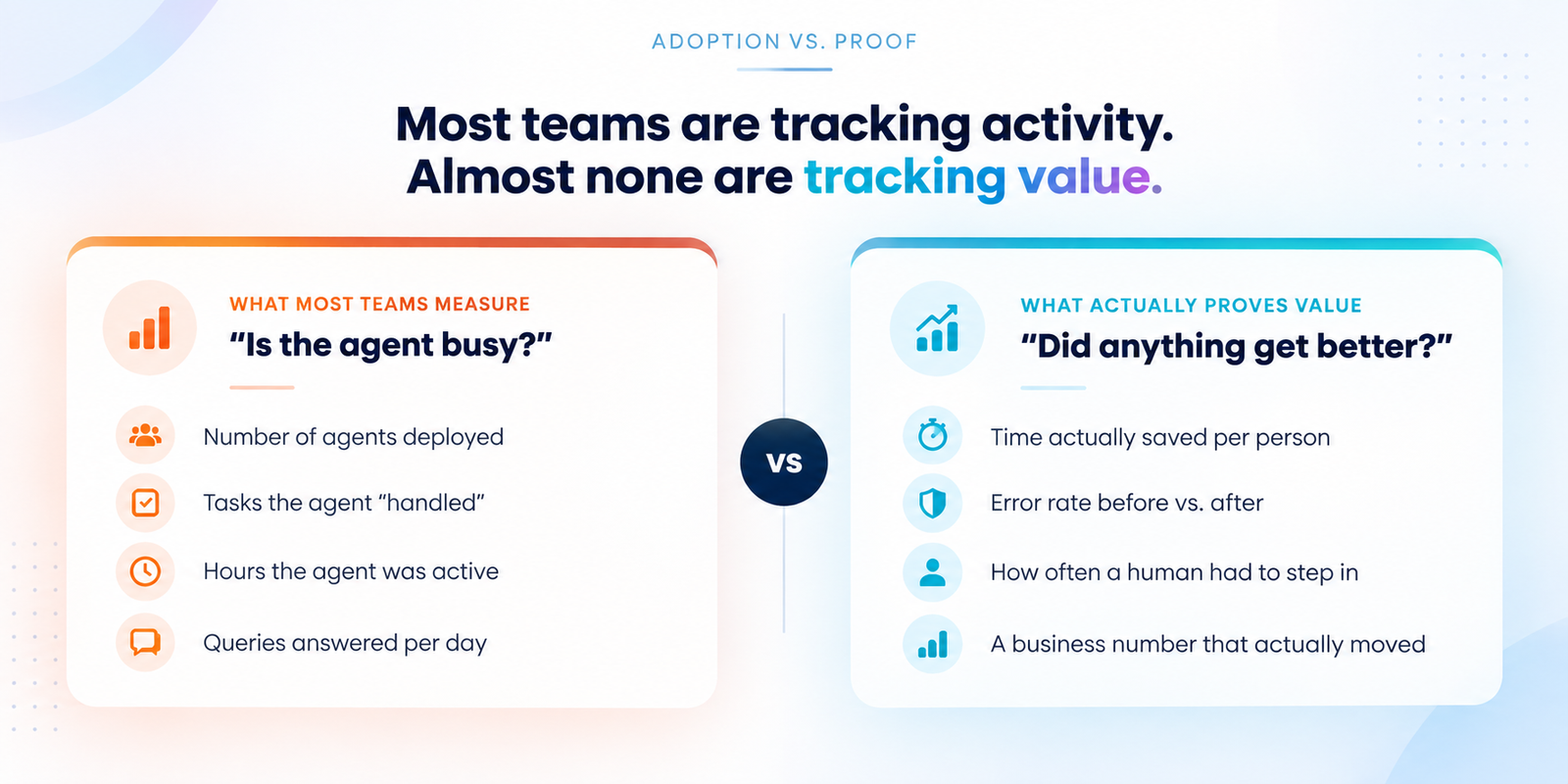
Busy isn't the same as useful
Most of the numbers teams report about their AI agents are activity numbers. How many tasks it touched. How many hours it ran. How many queries it answered. Those numbers go up and to the right, so it feels like progress.
But none of that tells you if the agent made anything better. An agent can "handle" a thousand tasks a day and still be creating more cleanup work than it saves, if the output is wrong often enough that someone has to check behind it. Busy and useful are two completely different things, and it's easy to mistake one for the other.
Why almost nobody measures the real thing
Measuring AI agent performance the right way is honestly just harder than counting activity. Counting tasks completed is a number your system already tracks. Measuring "did this actually save time" or "did errors go down" means you have to know what things looked like before the agent showed up, and most teams didn't bother capturing that baseline. Without a before, there's no way to prove an after.
There's also a quieter reason. If you actually measure outcomes, sometimes the answer is uncomfortable. It's easier to report "we deployed five agents this quarter" than to report "we deployed five agents and we're not sure two of them are doing anything."
An agent that's busy but unmeasured isn't a success story. It's just an unanswered question.
Three questions that actually tell you something
You don't need a complicated scorecard to get started. If you're trying to get a real read on Salesforce AI agent value, three honest questions get you most of the way there.
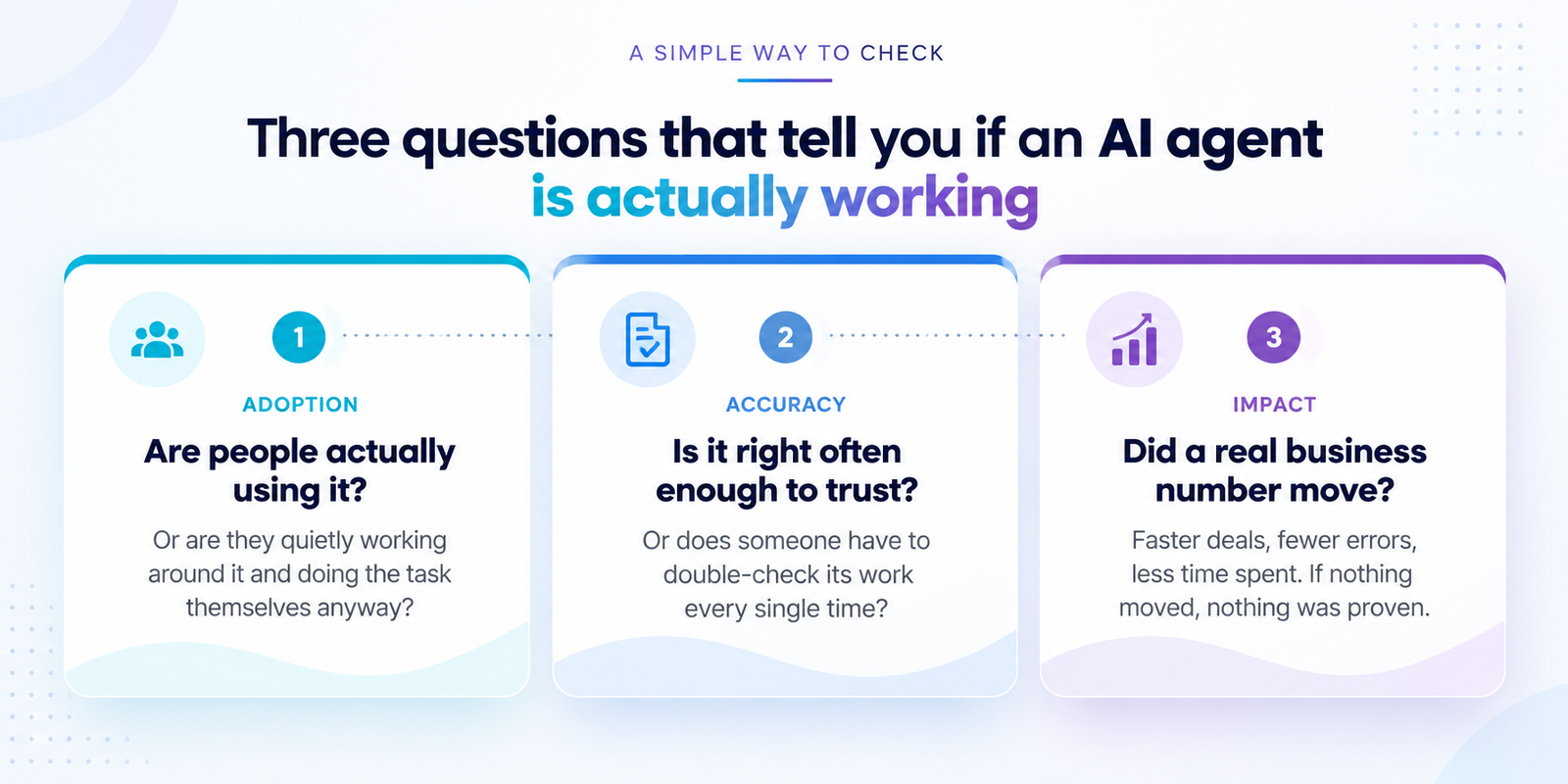
1. Are people actually using it?
Sometimes an agent gets rolled out, everyone nods, and then quietly, people keep doing the task by hand anyway because it's faster or they don't trust the output. If your team is working around the agent instead of with it, that's the real answer, no matter what the deployment dashboard says.
2. Is it right often enough to trust?
If a human has to double-check the agent's work every single time, you haven't saved time, you've just added a review step. Worth asking plainly: how often is it right, and how often does someone quietly fix it after?
3. Did a real business number move?
Deals closing faster. Fewer data errors. Less time spent on a task that used to eat up someone's afternoon. If none of these moved, it's fair to ask what the agent actually accomplished, activity aside.
Why this matters more every month
As more agents get added to more orgs, the cost of not measuring adds up quietly. That goes for Agentforce ROI just as much as any custom-built agent, since an unmeasured agent isn't neutral, it's either creating value nobody can point to, or creating extra cleanup work nobody's tracking either. Either way, it's a blind spot, and blind spots get more expensive over time, not less.
The teams getting real value out of AI agents right now aren't the ones with the most agents deployed. They're the ones who can actually answer the three questions above with a straight face.
This month, nCoder.ai is giving away 20 free custom AI instances to Salesforce teams who want to do this right from day one, built around your org's own workflows, not a generic agent bolted on top. Entries close September 30.
Enter the giveaway →What actually closes the gap
Measuring agent value isn't really about adding more dashboards. It starts earlier than that, with an agent that's actually tuned to how your org works, instead of a generic one dropped in and left to figure things out on its own.
This is where nCoder.ai comes in. Instead of a one-size-fits-all agent, you get a custom instance built around your org's own workflows and patterns, paired with AI Observability so you can actually see what the agent is doing and whether it's helping, not just guess. It's the difference between hoping an agent works and being able to prove it.
See how nCoder.ai helps you build, measure, and prove the value of AI inside your Salesforce org.
Book a demo →Where this leaves you
None of this means AI agents aren't worth the investment. It means the industry got ahead of itself a little, adopting fast and measuring slowly. That's fixable, and it starts with looking past AI agent adoption metrics like tasks completed and asking the three honest questions above instead.
If you're not sure whether your current AI setup is actually helping, that's a completely normal place to be right now, most teams are there too. The next step is just deciding to find out for real, and nCoder.ai is built to help you do exactly that.
Frequently asked questions
1. How do you measure ROI on an AI agent in Salesforce?
Look past activity metrics like tasks completed. Focus on adoption (are people actually using it), accuracy (how often is it right without a human double-checking), and impact (did a real business number, like cycle time or error rate, actually move).
2. Why do so few teams measure AI agent performance properly?
Mostly because it's harder than counting activity. Measuring real impact requires a "before" baseline most teams never captured, and outcome data can be less flattering to report than adoption numbers.
3. What's the difference between a generic AI agent and a custom one?
A generic agent is built for broad use cases and dropped into your org as-is. A custom instance, like the ones nCoder.ai builds, is shaped around your org's own workflows and patterns, which makes it easier to trust and easier to measure.
4. How can I get a free AI instance from nCoder.ai?
nCoder.ai is giving away 20 free custom AI instances to Salesforce teams this month. Entries close September 30, so it's worth applying soon if you'd like your org considered.