Is Your Salesforce Org Enterprise-Ready for AI? The Security and Compliance Checklist
The security question is blocking more Salesforce AI projects than any technical limitation. Here is what your CISO needs answered — and how to answer it.
The pattern shows up in almost every enterprise Salesforce AI evaluation. The technical teams are ready. The developers want it. The business case is clear. And then it reaches the security review — and stalls for weeks, sometimes months, sometimes indefinitely. Not because the AI isn't capable. Because the procurement team can't get clear answers to five straightforward questions about Salesforce AI security.
This blog exists to answer those questions directly. Whether you're the CTO who needs to unblock procurement, the architect who has to brief the CISO, or the team lead who just wants to know if nCoder.ai is safe to connect to your production org — here is the complete enterprise Salesforce AI readiness checklist, with honest answers for every requirement.
The biggest barrier to Salesforce AI adoption in enterprise isn't the technology. It's the security question nobody is answering clearly.
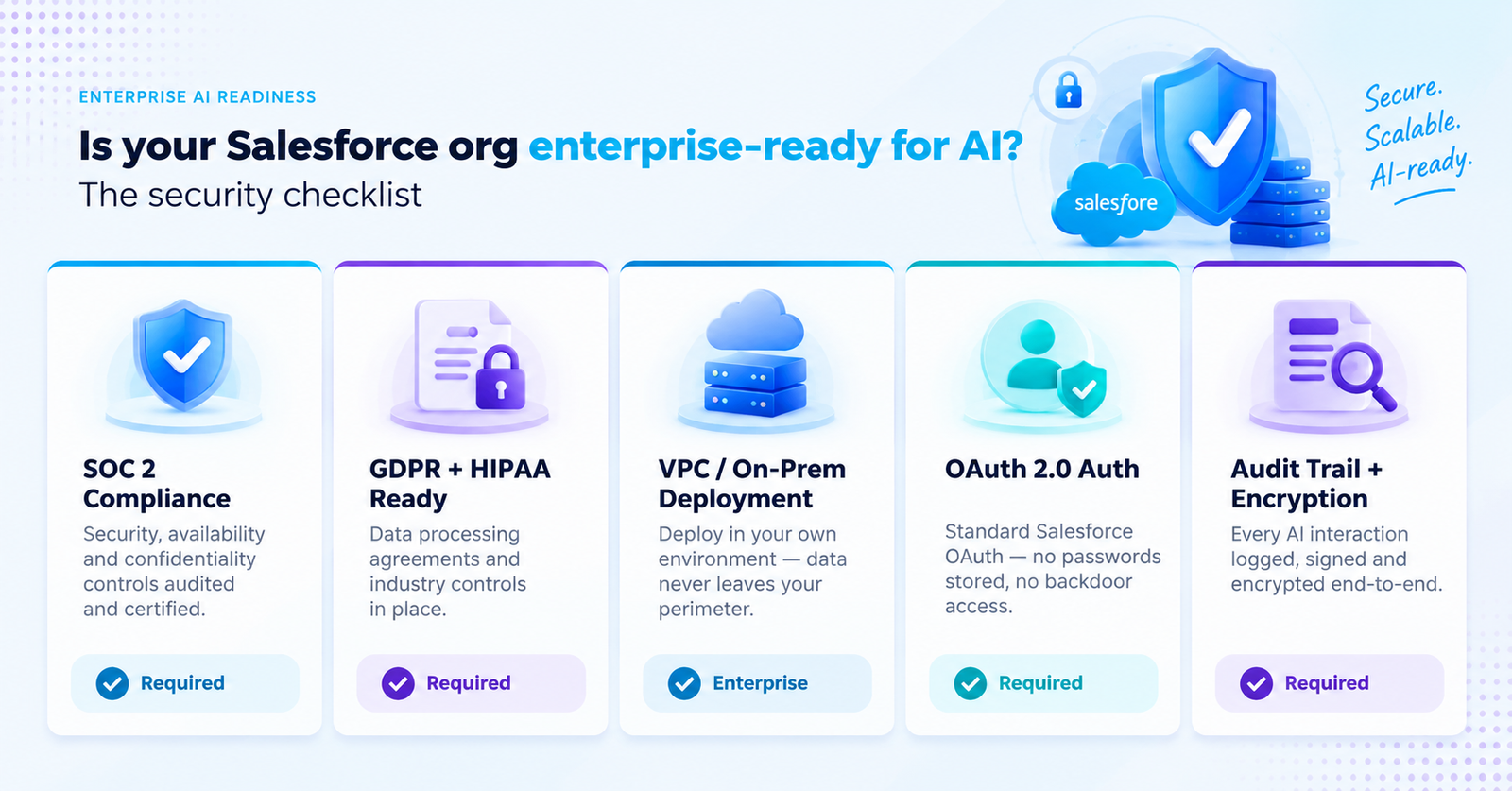
The five security requirements every enterprise asks about
1. SOC 2 Compliance
SOC 2 is the baseline requirement for any enterprise AI vendor touching production systems. It certifies that the vendor has independently audited controls for security, availability, and confidentiality. For Salesforce AI compliance, this means your CISO can request the SOC 2 report, review the controls, and make a documented procurement decision without relying on a vendor's self-assessment.
2. GDPR and HIPAA Readiness
Enterprise Salesforce orgs in regulated industries — financial services, healthcare, insurance, public sector — need GDPR and HIPAA controls in place before any AI platform touches their data. This means data processing agreements, explicit data residency commitments, and the ability to satisfy a data subject access request without needing to dig through AI vendor logs manually. Salesforce AI governance in regulated industries isn't optional — it's a legal requirement.
3. VPC and On-Premises Deployment
The most common security requirement in large enterprise environments is the simplest to state: the AI platform must deploy within your own cloud infrastructure, not the vendor's. VPC isolation means your data never traverses a shared environment. For air-gapped requirements — government, defence, highly regulated financial institutions — on-premises deployment must be an option. This single requirement eliminates most generic AI tools from enterprise Salesforce AI consideration immediately.
4. OAuth 2.0 Authentication
Any enterprise Salesforce AI platform connecting to your org should use standard Salesforce OAuth 2.0. No stored passwords. No backdoor API keys. No custom authentication schemes that create new attack surfaces. If an AI vendor can't connect via standard OAuth, that is itself a red flag worth investigating before any Salesforce data security AI conversation goes further.
5. Audit Trail and End-to-End Encryption
Every AI interaction — every query, every response, every code suggestion — should be logged, timestamped, attributable to a specific user, and encrypted at rest and in transit. Without it, you can't satisfy a compliance audit. Without encryption, you can't satisfy a security review. For teams already concerned about whether AI-generated Salesforce code can be trusted, the audit trail is the evidence layer that answers that question at the enterprise level.
How nCoder.ai is built for enterprise Salesforce AI security
nCoder.ai is built on a five-layer enterprise architecture designed to meet every requirement above — not as an afterthought added for enterprise sales, but as the foundation the platform was built on.
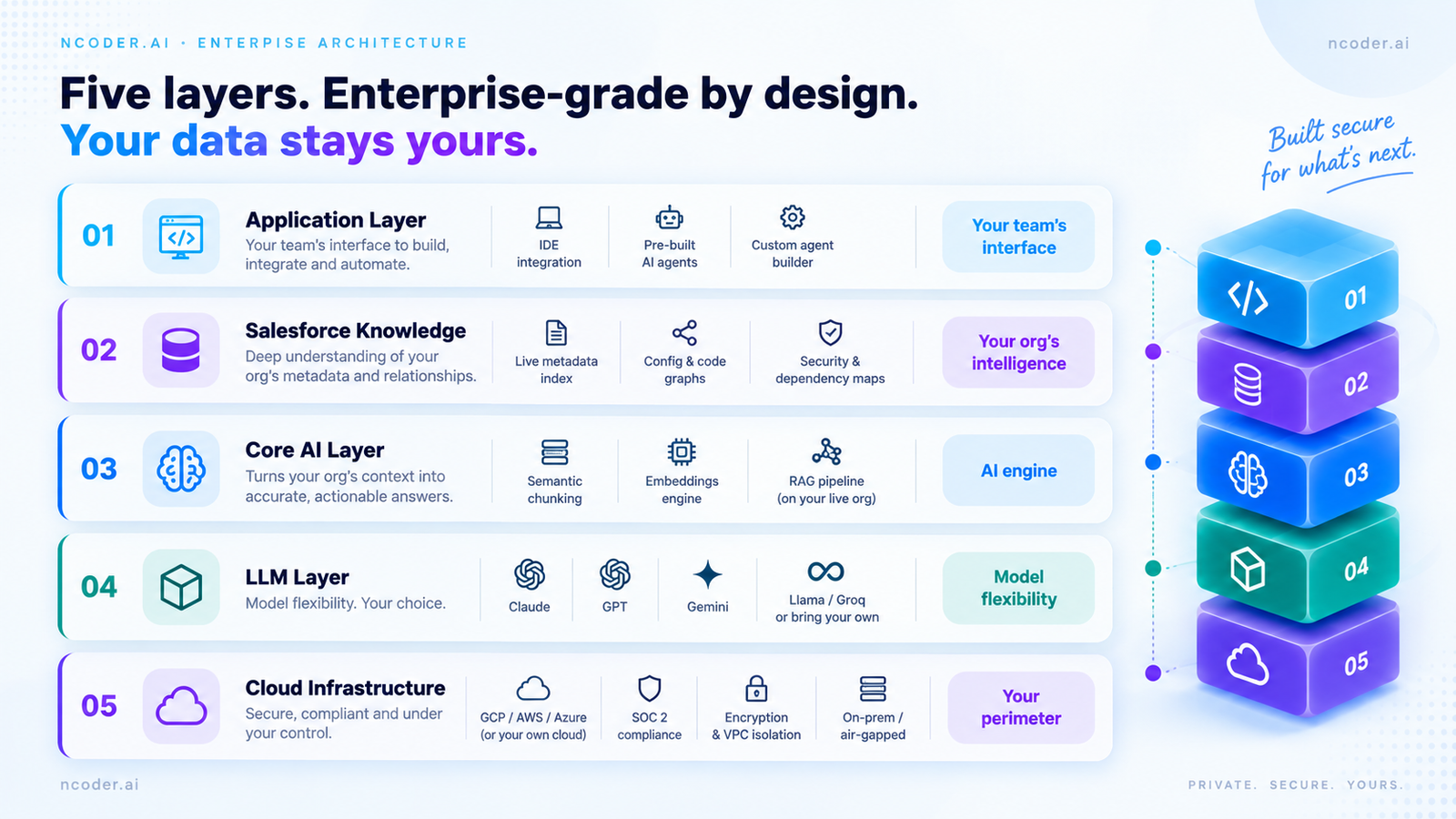
The architecture is model-agnostic at the LLM layer — Claude, GPT, Gemini, Llama or Groq, with the ability to bring your own via OpenAI-compatible API. At the cloud infrastructure layer, GCP, AWS and Azure are all supported alongside your own cloud. VPC isolation and on-premises deployment for regulated industries are standard options, not enterprise add-ons.
This is why teams managing multiple Salesforce orgs at enterprise scale choose nCoder.ai — the security architecture scales the same way the platform does. And because Salesforce AI tool consolidation onto a single platform reduces the attack surface compared to running six separate tools with six separate data flows, enterprise Salesforce AI governance actually gets simpler with nCoder, not more complex.
The questions your CISO will ask — answered
No. nCoder.ai connects via OAuth 2.0, reads metadata and code structures, and applies encryption end-to-end. No raw customer data is processed unless you explicitly connect it.
No. Your org's Graph RAG is built exclusively for your org and never used to train shared models. Your metadata stays in your environment.
Yes. VPC isolation is available as standard. On-premises and air-gapped deployment is available for regulated industries — your data never leaves your perimeter.
Yes. Every AI interaction is logged, timestamped and attributable to a specific user. The AI Observability dashboard gives your security team full visibility into what was queried, when, and by whom.
Is Salesforce AI secure enough for enterprise use?
Enterprise Salesforce AI security depends entirely on the platform's architecture. Purpose-built platforms like nCoder.ai are designed with enterprise requirements from the ground up — SOC 2 compliance, GDPR and HIPAA controls, OAuth 2.0 authentication, VPC and on-premises deployment options, and full audit trails on every AI interaction. The key questions for any CISO are: where does the data go, is VPC deployment available, and what does the audit trail look like.
nCoder.ai meets SOC 2, GDPR, HIPAA and VPC requirements as standard — so your security review takes days, not months.
Explore nCoder.ai →