Salesforce Auto-Documentation: Is AI-Generated Org Documentation Actually Reliable?
The honest answer — with the right AI, yes. With the wrong approach, absolutely not. Here is how to tell the difference.
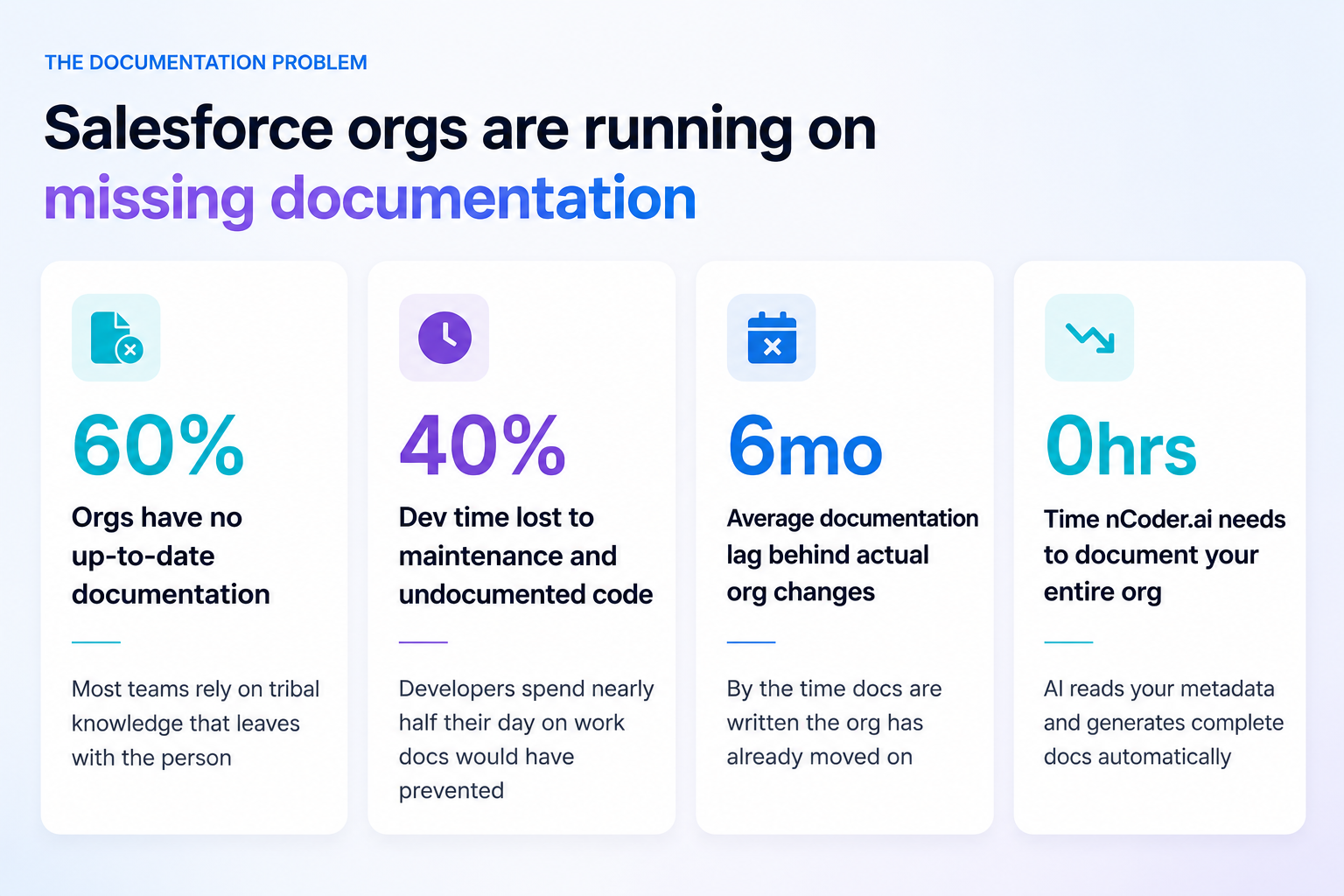
Ask any Salesforce team lead whether their org is properly documented and you'll get one of three answers. A confident yes that unravels the moment you ask a follow-up question. A sheepish no with a promise that it's on the roadmap. Or the most honest answer — a shrug, because the last person who knew the full picture left eighteen months ago.
Salesforce auto-documentation has been a promised solution for years — and the scepticism around it is just as old. But the scepticism is real and understandable. Most teams have tried some version of it — a wiki that went stale, a Confluence page nobody updated, a documentation sprint that produced something impressive for two weeks before the org moved on and left it behind.
"The problem was never that teams didn't want documentation. It was that maintaining it manually is a full-time job nobody was hired to do."
AI-generated Salesforce documentation changes the equation — but only if the AI actually understands Salesforce. And that distinction matters more than most teams realise before they try a generic solution and wonder why the output reads like it was written about a different kind of system entirely.
The honest concern about AI-generated documentation
Here is the question teams ask before they try automated Salesforce documentation — and it is a fair one. If an AI generates documentation about my org, how do I know it's accurate? How do I know it's not hallucinating class behaviour it doesn't fully understand? How do I know it will stay accurate as the org changes?
These are legitimate concerns about generic AI documentation tools. And the honest answer is — with generic AI, those concerns are valid. A large language model with no Salesforce context can read your Apex code and produce something that looks like documentation. But looking like documentation and being documentation are different things.
Generic AI tools document what they can read — the code. They miss the context: why a flow was built, what business process it supports, which downstream systems it connects to, and what happens to the org if it changes. That context lives in Salesforce's metadata layer, not in the code itself. And most AI documentation tools simply don't know how to read it.
What makes AI Salesforce documentation actually reliable
Reliable automated Salesforce documentation has three requirements that separate it from generic AI writing tools. The AI must understand Salesforce's architecture — the relationship between Apex, flows, metadata, and declarative components. It must read from the live org for complete Salesforce metadata documentation — not from exported snapshots. And it must update continuously, not on a schedule someone has to remember to trigger.
Not from exported files or manual inputs. Every Apex class, flow, validation rule, permission set, and API connection read from the source.
Knows the difference between a trigger and a flow, understands governor limits, can explain why a SOQL query matters in a specific context.
Documentation that requires a human to remember to update it will always be out of date. Reliable AI documentation is continuous, not periodic.
Technical docs for developers, business process docs for admins, architecture maps for architects. Different audiences need different views of the same org.
See how nCoder.ai documents your Salesforce org →
What nCoder.ai's Documentation Intelligence actually produces
This is where nCoder.ai works differently to anything else in the Salesforce documentation space. The Documentation Intelligence feature was built specifically for Salesforce — not adapted from a generic AI writing tool — which means it reads your org the way a senior Salesforce architect would, not the way a text summariser would.
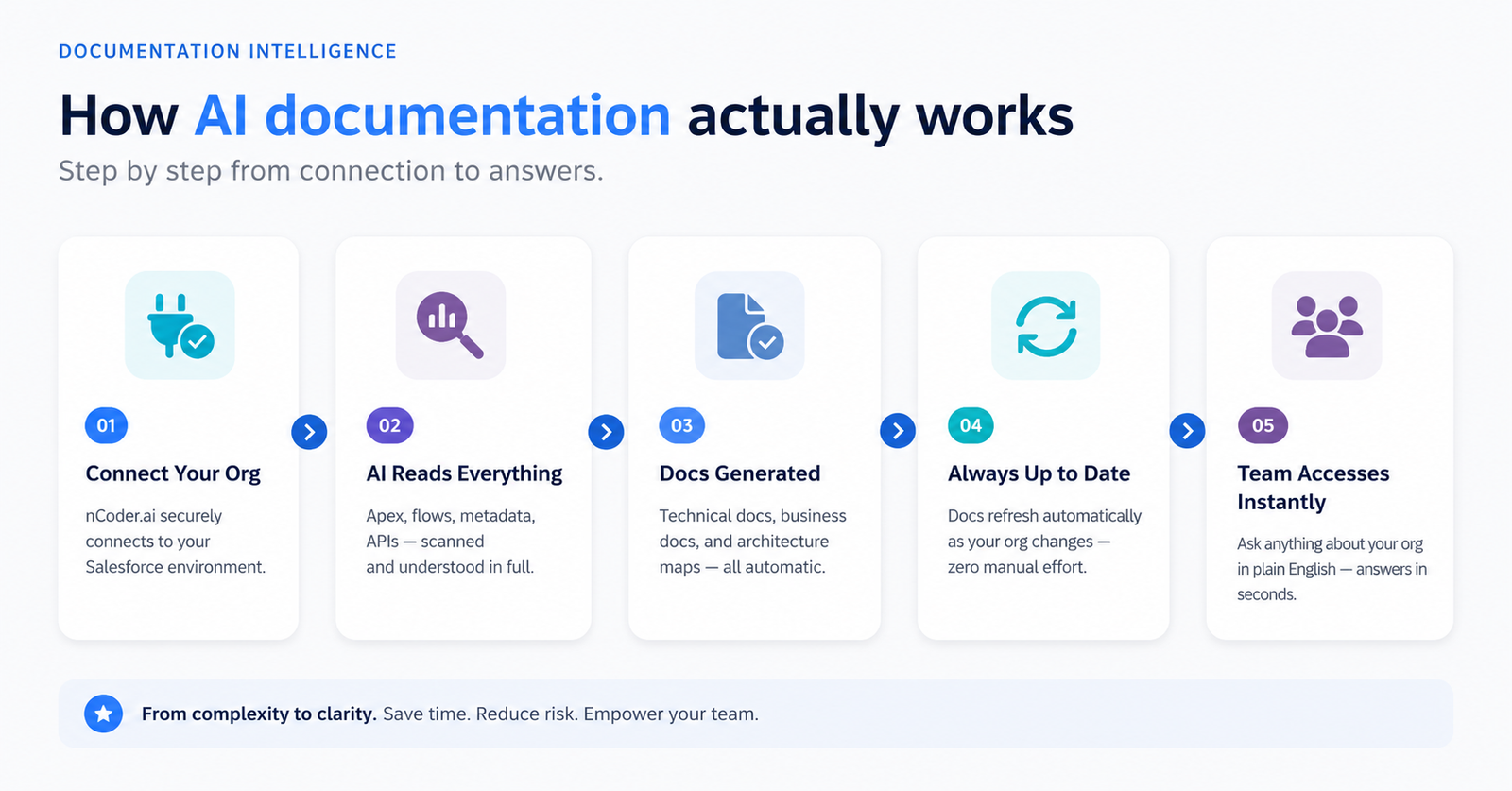
Connect your org to nCoder.ai and within minutes the Documentation Intelligence engine has read every Apex class, every flow, every metadata component, every API connection and external integration. It understands how they relate to each other — not just what each one does in isolation.
What comes out the other side is documentation that a senior developer would recognise as accurate, an admin could actually use to understand a business process, and an architect could trust to represent how the org is really structured — not how it was designed three years ago.
Apex class documentation, method-level descriptions, dependency maps, governor limit context. Written for developers by an AI that understands Salesforce development.
Visual representations of how your org is structured, how components connect, and where the critical dependencies sit — updated automatically as the org evolves.
Plain-English explanations of what flows and automation do in business terms — not just technical descriptions. Useful for admins, stakeholders, and new team members from day one.
Used as a Salesforce org documentation tool by engineering teams across the stack — ask any question about your org in plain English through nCoder.ai's Org 360 interface. Get instant answers sourced from live documentation.
"The question isn't whether AI documentation is reliable. The question is whether the AI doing the documenting actually understands Salesforce. That's the only thing that matters."
The teams using nCoder.ai for automated Salesforce documentation aren't just solving the documentation problem — they're eliminating it. New developers onboard in hours instead of weeks. Senior developers stop being the single source of truth. Leadership can ask questions about the org and get answers without pinging a developer at 4pm on a Friday.
Is AI-generated Salesforce documentation actually reliable?
With a purpose-built Salesforce AI — yes. The reliability comes from the specificity. Generic AI tools are reliable at generating text. nCoder.ai's Documentation Intelligence is reliable at generating accurate, current, Salesforce-specific documentation — because it was built for exactly that job and nothing else.
nCoder.ai generates complete Salesforce documentation automatically — technical docs, architecture maps, and business process docs — from day one.
Explore nCoder.ai →