The Blind Spot in Your Salesforce AI Agents and How to Fix It
Your AI agent can pass every test you throw at it and still cause a mess three days later. Here's why, and how nCoder.ai helps you catch it before it happens.
AI agents are now making changes inside Salesforce every day, and most teams are still only testing whether those changes work, not what they're connected to. That's the gap where things quietly go wrong, and it's one of the biggest Salesforce AI agent risks nobody's talking about yet. In this post, we'll show you exactly what a single "small" AI update can touch across your org, why your sandbox never catches it, and how nCoder.ai helps you see the full picture before an agent acts, not after something breaks.
Here's a scenario that's playing out inside more and more Salesforce orgs. An AI agent makes a small update. It passes every test. The record saves, the page loads, nothing throws an error. Everyone moves on.
Then a few days later, something's off. A contract that should've gone out never did. A number on a finance report looks wrong. Nobody can figure out why, because nothing "broke" in the way anyone tests for. This is exactly the kind of gap nCoder.ai was built to close, and it's what this post is about.
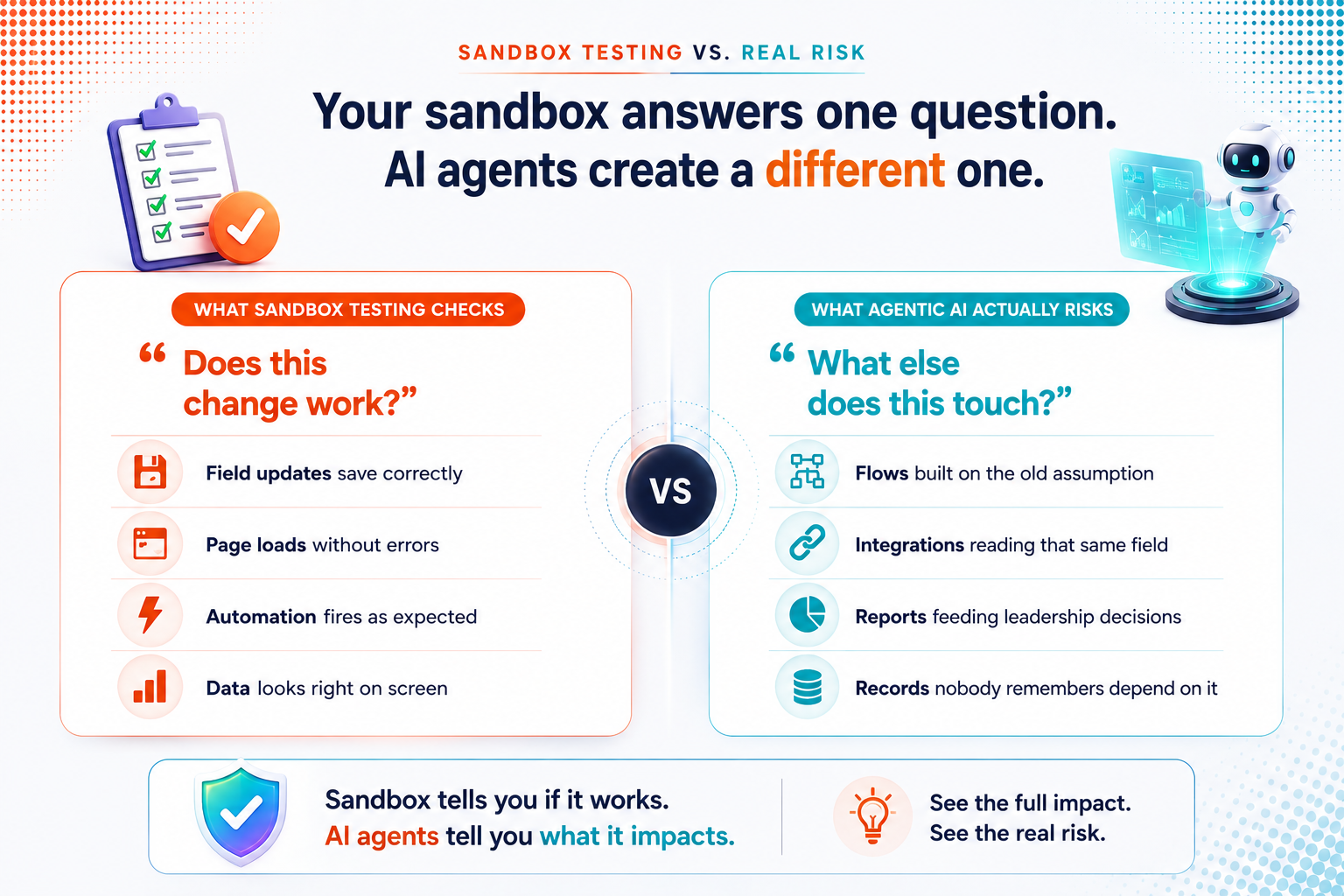
Your tests only ask one question
Sandbox testing is good at one thing: checking if a change works. Did the field save? Did the page load? Did the automation fire? Yes, yes, yes. Ship it.
But it never asks the other question. What else is quietly relying on this thing you just changed? A flow built two years ago. An integration syncing data overnight. A report someone in leadership checks every Monday. None of that shows up in a functional test. It only shows up once it breaks.
Why AI agents make this worse
A human making changes usually has some instinct for risk. They might pause and think, "wait, does anything else touch this?" An AI agent doesn't do that. It just does the task, fast and confidently, with no idea what's sitting downstream.
That's not really the agent's fault. It's doing exactly what it was asked to do. The real issue is that nobody checked what was connected before the agent got involved.
AI agents don't make bad decisions. They make fast decisions in a system where nobody mapped the consequences first.
Let's look at one real example
Say an AI agent updates the Stage field on an Opportunity. Sounds harmless, right? This is where an AI agent's blast radius comes in, the full set of things that could be affected by that one change. Here's what's actually wired up to that one field in a typical org:
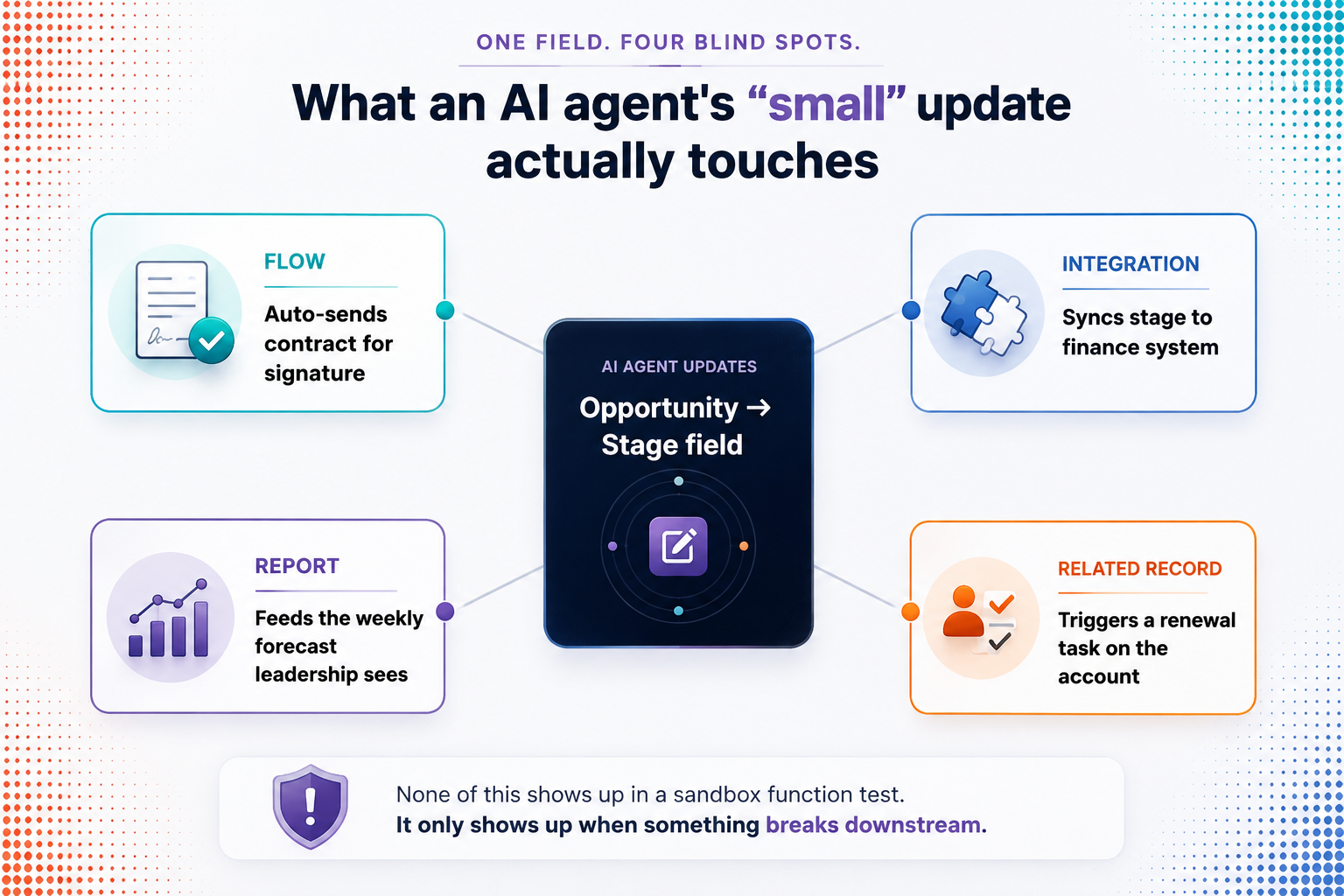
A flow that auto-sends a contract. An integration syncing that field to finance. A report leadership actually looks at. A task that's supposed to fire on a related account. Your sandbox test never sees any of this. It only shows up once something downstream quietly stops working.
Why nobody caught this until now
Honestly, most teams got away with skipping this for years. Changes moved at human speed, which was slow enough for someone to usually notice if something felt off. There was time to catch it.
AI agents remove that time. They're working constantly, across more of the org than any one person keeps in their head, and they don't slow down to double-check themselves. The connections were always there. They just didn't matter as much until something started moving through them this fast.
So what actually fixes this?
Testing harder isn't the answer. You can't test your way out of not knowing what's connected to what. What actually helps is Salesforce dependency mapping, seeing those connections before anything changes, not after.
That's exactly what nCoder.ai's Salesforce impact analysis does. Before a change goes live, it shows you what's connected to it, the flows, integrations, reports, and related records, so you're not finding out the hard way. Pair that with Org 360, which gives you a live, full view of how your org actually fits together, and you get the kind of visibility a sandbox test was never built to give you.
It's a simple shift, really. Instead of asking "did that work?" after the fact, you start asking "what will this touch?" before the fact. That's exactly the question your AI agents need someone, or something, asking on their behalf.
nCoder.ai maps what's actually wired up across your Salesforce org, so changes stop being a guessing game.
Book a demo →Where this is all heading
More Salesforce teams are handing everyday work to AI agents, and this exact problem is only going to show up more, not less. Speed without visibility is exactly how a small, routine change turns into a surprise nobody wanted.
None of this means AI agents shouldn't be doing this work. It just means the safety net underneath them needs to catch up. Sandbox testing still matters, it's just not the whole story anymore. Knowing what's connected is the other half, and it's the half most teams haven't built yet.
If your team is using AI agents in Salesforce, or thinking about it, ask yourself one honest question: does anyone actually know what's connected to what across your org? If the answer is "not really," that's the gap worth closing first. This is the core of good Agentforce risk management, and it's exactly what nCoder.ai was built for.
Frequently asked questions
- Why doesn't sandbox testing catch problems caused by AI agents?
Sandbox testing checks whether a change works, not what it's connected to. AI agents act fast across the org, so the real risk becomes "what did this touch," and that's not something a functional test is built to answer.
- What is a "blast radius" in Salesforce?
It's everything that could be affected by one change, the flows, integrations, reports, and records that quietly depend on a field or piece of metadata. Most teams don't see their blast radius until something breaks.
- How can Salesforce teams manage risk from AI agents?
The best approach is mapping what's connected before a change happens, not just testing after. nCoder.ai's Impact Analysis and Org 360 give teams that visibility, so AI agent actions can be checked for downstream impact before they go live.
- Is this different from regular Salesforce QA and deployment testing?
Yes. Regular QA and deployment testing confirms a change works. Dependency mapping shows what else in the org relies on that same thing, a layer that matters more as AI agents act with less manual oversight.