What Is Graph RAG — and Why Does It Make Salesforce AI 35% More Accurate?
Every Salesforce AI tool claims to be intelligent. The difference is whether it's intelligent about your org specifically — or just guessing.
When a Salesforce developer asks an AI tool "what will break if I deprecate this field?" — the answer depends entirely on what the AI actually knows. A generic AI gives an answer based on how Salesforce usually works. An org-specific AI gives an answer based on how your Salesforce works. The gap between those two answers is the gap between Salesforce AI accuracy and Salesforce AI guesswork.
Graph RAG is the technology that closes that gap. And understanding what it is — in plain terms — explains why nCoder.ai delivers 35% more accurate answers than generic AI tools on Salesforce-specific questions.
"Every Salesforce org is unique. AI built from public code treats them all the same. That's where the accuracy problem starts."
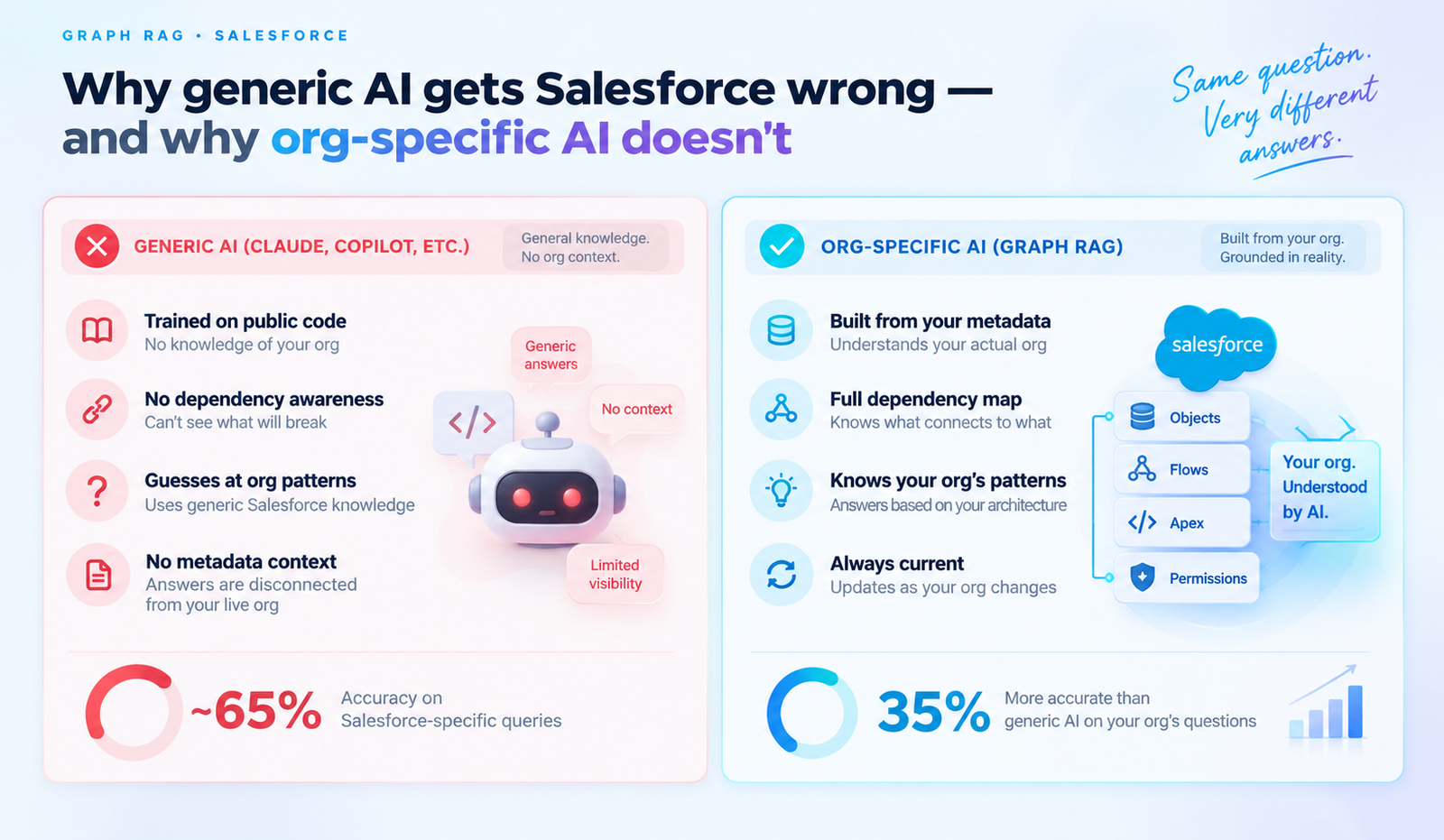
Why generic AI gets Salesforce wrong
Generic AI tools — copilots, coding assistants, general-purpose models — are trained on publicly available code and documentation. They know a lot about Salesforce in the abstract. They know what an Apex trigger is, how flows work, what governor limits exist. But they have no knowledge of your Salesforce org. Your custom objects. Your field relationships. Your trigger framework. The dependency between that Opportunity field and the contract automation three layers downstream.
This is what Salesforce AI org intelligence and Salesforce AI context awareness actually mean — and generic AI has none of it. When it answers a question about your org, it's applying general Salesforce knowledge to a specific situation it has never seen. That produces answers that are often plausible but frequently wrong in ways that matter — wrong dependencies, wrong impact assessments, wrong security assumptions.
What Graph RAG actually is — in plain English
RAG stands for Retrieval-Augmented Generation. It means the AI retrieves relevant information before generating an answer — so instead of relying purely on training data, it pulls in current, specific context first.
Graph RAG takes this further. Instead of retrieving from a flat document store, it retrieves from a knowledge graph — a map of interconnected entities and relationships. For Salesforce, that graph contains every object, every field, every trigger, every flow, every Apex class, every dependency in your actual org.
Think of the difference between asking a new consultant who has read Salesforce documentation, versus asking someone who has spent six months inside your specific org. The consultant knows Salesforce. The insider knows your Salesforce. Graph RAG is how nCoder.ai becomes the insider — automatically, from the moment it connects to your org.
What n-hop reasoning means for Salesforce AI accuracy
The "n-hop" part of nCoder's Graph RAG Salesforce intelligence refers to the ability to follow chains of relationships through the org graph — not just one step, but as many steps as the question requires. If you ask what will break when you change a field on Account, a one-hop answer finds objects that directly reference that field. An n-hop answer follows the full chain — the trigger, the flow it fires, the Apex class that flow calls, the API that class touches. A generic AI doesn't know any of them exist in your org. nCoder.ai's Graph RAG follows every hop to the end.
What 35% more accurate actually means in practice
The 35% improvement in AI Salesforce development accuracy from Salesforce Graph RAG AI shows up in three places that matter most to a Salesforce engineering team.
nCoder correctly identifies what a change will affect, including downstream dependencies that generic AI has no visibility into. Fewer surprises in production.
Org-specific Salesforce AI generates code that fits your actual schema, your actual field names, your actual relationships — not a generic approximation.
Identifying real vulnerabilities requires knowing your real permission structure. Graph RAG applies your rules, to your org, in your context.
This is why Salesforce specific AI built on Graph RAG isn't just faster than generic AI — it's qualitatively different. The answers it gives are grounded in evidence from your org, not inferences from public training data.
We are giving 20 Salesforce teams a free nCoder.ai AI instance — connected to their real org, running Graph RAG on their actual metadata, delivering org-specific AI accuracy from day one. 20 spots. One per organisation.
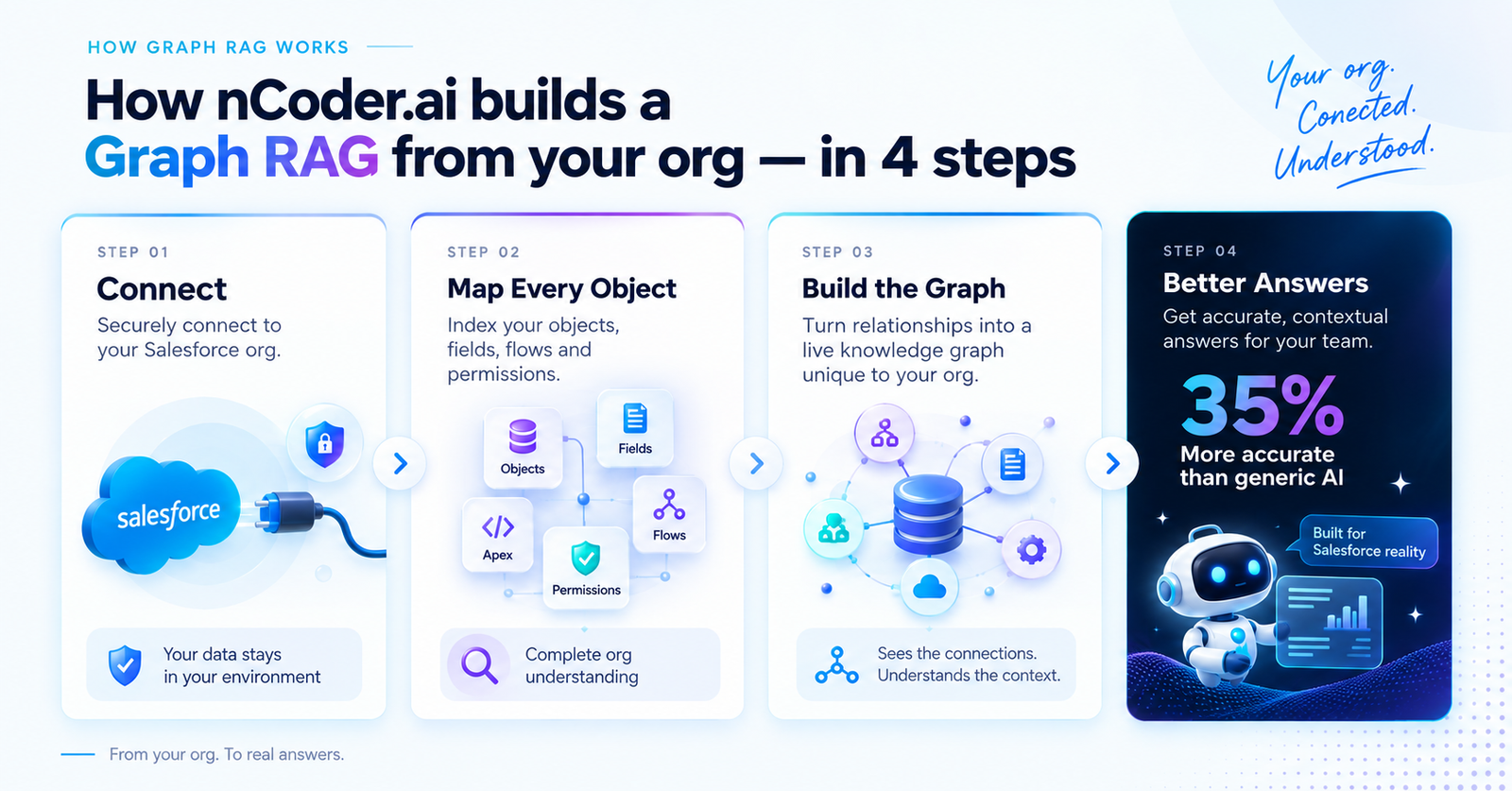
Enter the September Giveaway →Graph RAG (Retrieval-Augmented Generation using a knowledge graph) improves Salesforce AI accuracy by grounding AI answers in your specific org's metadata rather than generic Salesforce knowledge. nCoder.ai connects to your live Salesforce org, maps every object, field, flow, trigger and dependency into a knowledge graph, then uses that graph to retrieve org-specific context before generating any answer — producing 35% more accurate answers than generic AI tools.
nCoder.ai builds a Graph RAG from your live org — automatically — so every answer, every impact analysis and every code suggestion is grounded in your actual Salesforce environment.
Explore nCoder.ai →